One Ingredient Story, Three Meanings: Healthy Aging Consumers in India, Korea, and Australia
One Ingredient Story, Three Meanings: Healthy Aging Consumers in India, Korea, and Australia
A recap of All In on Asia, the September 16, 2026 webinar from the Industry Transparency Center (ITC) and HMT, the Healthy Marketing Team.
Healthy aging is one of the busiest categories in wellness, and the pull to copy what’s working for someone else is strong. A claim that sells in one market feels like it should sell in the next.
ITC’s data points the other way.
At All In on Asia, held with HMT right after Vitafoods Asia in Bangkok, ITC’s CEO Len Monheit walked through consumers in India, Korea, and Australia who share a concern about aging. They share a category. On almost everything else that drives a purchase, they split. So each market needs an approach built around what its own consumers care about.
Where the data comes from:
ITC is a consumer research and business strategy firm covering food, beverage, and supplements. Its 2025 supplement consumer survey spans seven countries (the US, UK, Germany, Italy, Korea, Australia, and India), roughly 4,000 participants, and 39 distinct health concerns.
For this analysis, ITC pulled out everyone in India, Korea, and Australia who flagged an aging-related concern: 317 consumers in India, 342 in Korea, and 273 in Australia. That’s 932 people, and 55 to 60% of everyone surveyed in each country. It’s a big enough group to break each market down by age and gender and see what drives a purchase in each segment.
The short version:
- India: 39% of aging consumers buy on a healthcare professional’s recommendation, against 23% of all users.
- India: more than 60% rate branded ingredients as important, double the all-user average.
- Korea: willingness to pay a premium for branded ingredients peaks at 37% (men 35 to 44), slightly below the all-user average.
- Australia: aging consumers are about half as likely as the average buyer to pay more for a branded ingredient.
India: the doctor is the gatekeeper:
India’s top concerns are hair loss, digestive complaints, fatigue, anxiety and stress, and skin health. Len was clear on this point: these are the full-scope top concerns for this group. Aging is the bucket ITC sorted them into, and few of these consumers would name it as their problem if you asked.
ITC’s data puts the healthcare professional at the center of the purchase. 39% of India’s aging consumers buy on an HCP’s recommendation, against 23% of all users. Natural sourcing over-indexes too (21% vs. 17%), and so does clinical research on both the ingredient and the brand. When they look for ingredient information, 68% go to a healthcare professional, against 46% of all users. Health apps and wearables, online influencers, and brand websites fill out the list.
ITC splits each market into 10 age and gender segments and builds a full persona for each one, covering health concerns, purchase attributes, trust drivers, and values. Len walked through two from India.
The Family Health Protector is women aged 35 to 44, the largest female cohort in the India data. Hair loss, mood, and nutrition top her list, and a healthcare professional’s recommendation carries more weight than anything else. Her profile in one line: “I’m managing my family’s health and my own at the same time. I need supplements I can trust and a brand that proves it.”
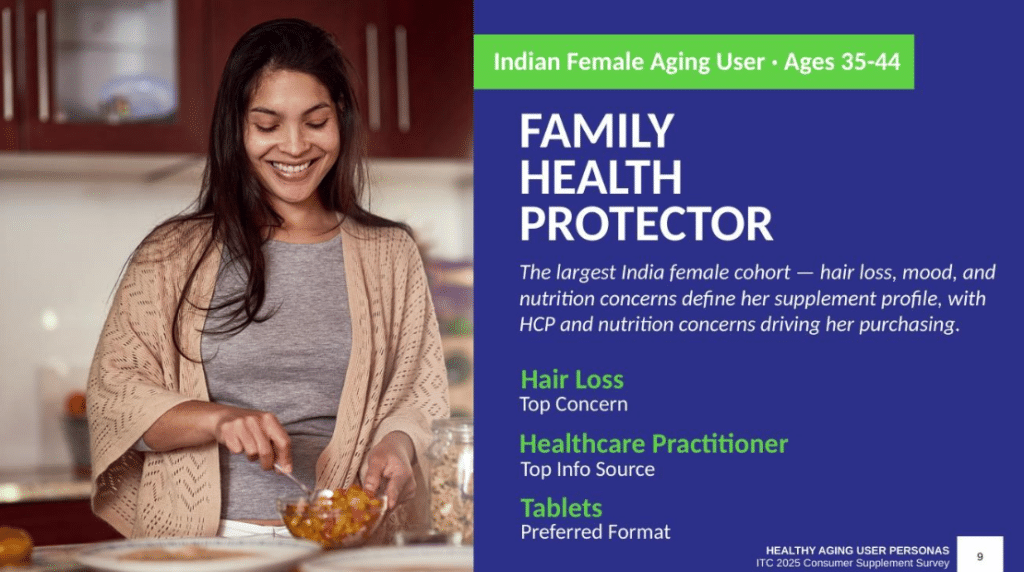
The Active Vitality Maximizer is men in the same 35 to 44 band. He’s dealing with hair loss, nutrition, and high blood pressure, wants detailed ingredient information before he buys, and prefers powders.
So in India, trust runs through the doctor. And branded ingredients work as a real price lever, because these consumers will pay more for them.
Korea: digital trust replaces clinical trust:
Korea’s top concerns are fatigue and tiredness, anxiety and stress (both skewing female), skin health, and digestive complaints. Overweight and poor hydration show up further down the list.
Then the purchase drivers flip. In ITC’s data, Korean aging consumers over-index on proof of safety (27% vs. 18% for all users), detailed ingredient information (25% vs. 15%), online ratings and reviews (20% vs. 13%), and branded ingredients (15% vs. 8%). The two drivers that dominate India drop below average: healthcare professional recommendation (19% vs. 23%) and natural sourcing (6% vs. 17%). As Len put it, “quite a contrast from India.”
Korean consumers do their own homework. 51% go to web search and AI tools for ingredient information, against 40% of all users, and the response is sharpest among men 18 to 25. Brand websites and influencers play a supporting role.
Two Korea personas came up on the webinar. The Eye & Energy Health Strategist is focused on eye fatigue along with energy and vitality. The Cardiovascular & Vitality Defender cares about heart health and athletic performance. Both fit the data: they research online and buy on what the product and the brand can prove.
Korea’s full persona set goes much deeper than two profiles, and so does the purchase-driver data behind each one.
Australia: trust built over time:
Anxiety and stress is Australia’s #1 concern, followed by joint and bone discomfort, fatigue, and skin health. Healthcare professional recommendation is still the top single driver, but it sits right at the all-user average (24.5% vs. 23.3%). What over-indexes is wanting a product that addresses a specific condition (29% vs. 19%).
The bigger factor is time. Australian consumers stick with brands that keep their formulations consistent and stay reliable year after year. ITC calls it earning the relationship.
Then there’s the most surprising number in the dataset. Australia’s aging consumers are about half as likely as the average buyer to pay a premium for a branded ingredient, in the market with the widest growth opportunity of the three. A branded-ingredient story that sells in India won’t carry the same weight here.
One ingredient story, three meanings.
Put the three markets side by side and Len’s line from the webinar sums it up: one ingredient story, three meanings. A branded ingredient sells the product in India. In Korea it signals quality, but consumers won’t pay extra for it. In Australia it rarely drives the purchase.
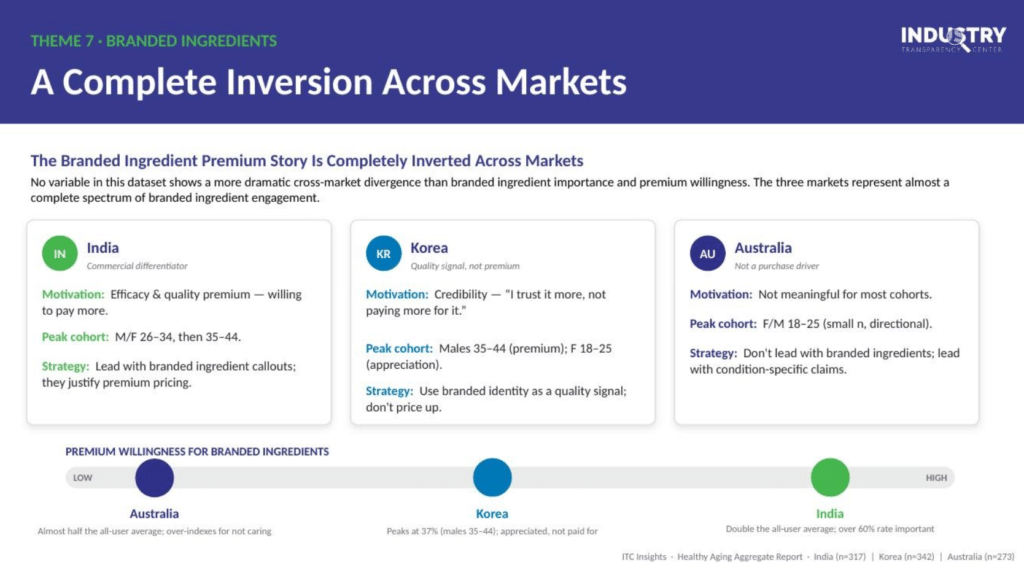
The split traces back to how each market builds trust. India runs on what Len called a dual trust architecture: a healthcare professional’s recommendation plus a quality certification or seal. Korea runs on consistency and brand recognition. Australia runs on a brand’s track record, with HCP recommendation and clinical research in a supporting role.
Even “proof” means something different by market. Indian consumers want ingredient details and a Certificate of Analysis. Korean and Australian consumers start with ingredient information and add country of origin. And in Australia, the real hurdle is believable label claims. Len called that a trust problem, even in a market with real regulatory oversight.
Where the cross-market opportunities are:
ITC’s data shows the same pattern in all three markets: high concern, low action. Far more consumers are worried about their health than are buying anything for it. A few gaps stand out.
Anxiety and stress. It peaks at 26 to 34 in India, where it ties into gut-brain and immunity messaging. In Korea it skews younger and female and travels with fatigue and mental energy. In Australia it’s the top concern and the widest gap between concern and supplement use in the dataset. The message has to flex by market: practitioner endorsement in India, digital and AI-friendly ingredient education in Korea, condition-specific claims in Australia.
Digestive health. It makes the top concerns in all three markets, but the gaps sit in different places: wide open across India, tied to weight concerns in Korea, and concentrated in older consumers in Australia.
The 35 to 44 cohort. In each market, the widest conversion opportunity sits in this age band’s gender-skewed segment: women in India, men in Korea, and women again in Australia.
Perimenopause. This one is market-specific. India’s dataset has no perimenopause data. Korea shows real whitespace for women 55 and up, alongside eye fatigue, joint pain, and memory concerns. Australia shows it for women 45 to 54, tied to anxiety, insomnia, and mood.
Where the data hands off to brand strategy:
The data shows where the opportunity sits in each market. What a brand does with it is where HMT picked up the session. Marit Veenstra and Thanyathorn Wongnitchakul walked through how HMT turns consumer insight into brand trust. Here’s their framework, in their words.
The four questions every consumer answers
HMT’s methodology starts from the consumer, not the ingredient. The FourFactors® are the decision points that go through a consumer’s mind at the point of purchase, and you need to get all four right.
Do I NEED this? Do I UNDERSTAND the benefit? These two create the motivation to pick your product up.
Do I ACCEPT the ingredient? Do I TRUST the brand? These two give permission to buy.
Most brands can answer 2 and 3, the ingredient and benefit link. But 1 and 4, who needs this and do they trust you, are the harder axis, and the one that decides who wins in a sea of sameness.
Excellent science can still fail on understanding. A clear benefit can still fail on trust.
Four consumers, four ways to build trust
HMT’s other point: there’s no single healthy ager. The shift into caring about healthy aging comes with health awareness, and that can hit at 25 or at 60. HMT maps four consumer groups, and each one needs a different reason to say yes.
- Technology consumers need to change because of a condition or symptom. They trust scientific proof, health claims, and doctor endorsement.
- Lifestyle consumers want to change, driven by belief, identity, and trends. They trust brands that reflect who they are or want to become, and they’re where novel ingredients and new formats belong.
- Early Mass consumers are open to solutions that fit a busy life. They trust familiarity, convenience, and taste, so the healthy choice has to be an easy swap for something they already do.
- Mass Market consumers don’t want to change at all. They trust the gold standard of the category: traditional, inclusive, and built for the whole family.
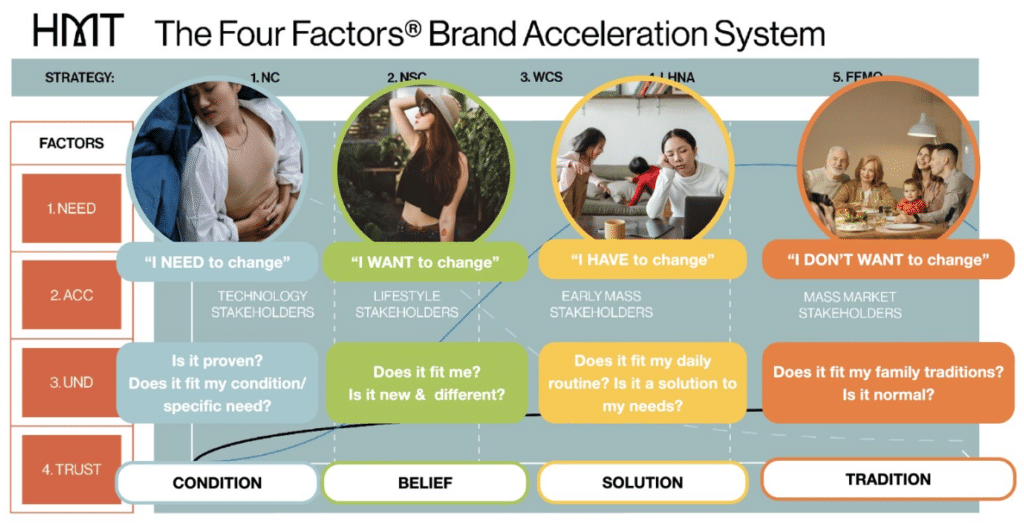
The two frameworks fit together. ITC’s personas tell you who the consumer is in a given market and which trust signals they respond to. HMT’s groups tell you how ready that consumer is to change. A brand needs both answers.
Want the full picture?
Everything here is a narrow slice of ITC’s research. The healthy aging data for India, Korea, and Australia comes out of a seven-country survey of roughly 4,000 supplement consumers. ITC’s full program includes the complete persona library and reports built around a specific ingredient, condition, or market.
If your brand is weighing where to focus next, in Asia or anywhere else, or wants this analysis built around your own category, talk to ITC.
Get in touch: len@itcstrategy.com