
Signal Vs. Noise
Signal Vs. Noise: Three Shifts in How Consumers Trust Supplement and Functional Food Brands
WHY THIS CONVERSATION MATTERS
The supplement and functional food industry has expanded significantly over the past decade, with new audiences entering the market, product innovation accelerating, and consumer engagement with health and nutrition continuing to grow. But industry growth brings heightened scrutiny. The expectations consumers bring to brands are rising alongside the industry, and what it takes to earn their trust is shifting, from promise to proof.
This brief draws on ITC’s 2025 Consumer Supplement Survey (n=4,029 across seven countries, including 1,003 US respondents) and the 2025 Functional Food and Beverage Consumer Survey (n=2,003, US and UK) to map where consumer trust signals are moving, and what it means for brand and ingredient strategy.
WHAT’S HOLDING STEADY
Before addressing what’s shifting, it’s worth establishing what isn’t.
Healthcare professional (HCP) recommendation remains the #1 trust driver for supplement brands across nearly all countries surveyed, the top response in the US, UK, Australia, Italy, and India. In Germany, clinical research holds the top spot; in South Korea, it’s a quality certification. In the US, HCP recommendation, consistent product quality, and long-term brand use have held as the top trust drivers for six consecutive years of ITC tracking (2020–2025).
In functional food and beverages, nutritional profile and consistent product quality are the top two measures of brand trust in both the US and UK.
These are the constants. They define the minimum expectations. Brands that don’t deliver on basic product quality and haven’t earned recognition from clinicians aren’t starting from a neutral position, they’re starting from behind.
WHAT’S CHANGING: THREE SHIFTS WORTH WATCHING
Shift 1: Proof-based signals are rising
Across both surveys, consumer demand for verifiable, substantive proof signals is increasing. In ITC’s US supplement data (2020–2025), clinical research on the ingredient and on the brand has become a more important factor in purchase decisions. Certificate of Analysis and proof of testing gained meaningful ground in 2023 and have held that level through 2025.
In functional food and beverage, a healthcare professional recommendation rose from fifth to third between 2023 and 2025, moving up alongside quality certifications that have held the top position for years. These signals do differ slightly: HCP recommendation is interpersonal, quality certification is institutional, clinical research is evidence-based. But they share a defining characteristic: each can be pointed to, verified, or endorsed by someone outside the brand. Taken together across both surveys, this category of signals is holding steady or gaining ground. What’s declining is the category with no equivalent external anchor: brand storytelling, influencer endorsement, and narrative-only claims.
Shift 2: Story Without Substance Is Losing Ground
In ITC’s FF&B survey, “authentic brand story” has decreased as a trust driver year over year. Across both surveys, social media influencers and cause/charity alignment consistently rank last among all trust factors in both the US and UK.
This is not an argument against brand storytelling. It is an observation that the story alone, built on heritage, authenticity, or values alignment, is doing less of the work it once did. What’s changing is what the story needs to be built on.
Shift 3: Consumers are paying more for proof
Perhaps the most strategically significant finding in ITC’s multi-year supplement data is the trajectory of consumer willingness to pay a premium for branded ingredients. Since 2020, there has been a consistent year-over-year shift away from “I don’t care about branded ingredients” toward “I always look for them and I’m willing to pay a premium.”
In the US: 2024 saw a 6% increase in consumers saying they always look for branded ingredients and are willing to pay a premium. 2025 added another 4%. Globally, 2025 marks the first year that willingness to pay a premium for branded ingredients outpaced unwillingness in every country surveyed.
Clinically supported, branded ingredients are commanding a real and growing market premium. For brands investing in what actually goes into the product, consumers are paying for it.
THE INFORMATION PARADOX
Consumers consistently say that healthcare professional recommendation is their top trust driver for supplements. But when asked where they actually go for ingredient information, brand websites have now become the primary source in the US, UK, South Korea, and Australia, overtaking general web searches for the first time. In the US specifically, the brand website’s importance has increased across three consecutive survey years while broad web search has declined.
One segment exception is worth noting: for males 18–25, online influencers are the leading source of supplement ingredient information. Whether that cohort applies the same credibility standard to influencer-sourced content as older consumers apply to clinical sources is a question the data doesn’t yet answer, but it’s one brands targeting that demographic need to take seriously.
Consumers hold HCP recommendation as the standard they want brands to meet, and then go to brand-owned channels to decide whether a brand meets it.
The question for every brand and ingredient company is whether the content they’re serving at that moment of investigation looks like something a credible health professional would stand behind, or like marketing.
THE COST OF GETTING IT WRONG
When ITC asked supplement consumers to rate their concerns about quality, safety, and regulation, the most prevalent issue reported was false and misleading claims, especially among females aged 26–34 and consumers over 45. Their main worry was deception. Not contamination. Not safety.
The market consequences of getting this wrong are real and recent. In December 2024, a federal court ordered Quincy Bioscience to immediately cease all memory-improvement claims for Prevagen, including “clinically proven” language, after seven years of FTC litigation determined the claims were materially misleading and unsupported by adequate science. The product’s entire marketing identity had to be rebuilt from scratch.
In the gut health space, Poppi, a prebiotic soda brand that built its positioning almost entirely around “gut healthy” claims, agreed to an $8.9 million class action settlement in 2025. The core issue was dose insufficiency: each can contained only two grams of prebiotic fiber, far below the threshold needed to deliver a meaningful gut health benefit.
In the broader cognitive supplement space, the pattern repeats. Alpha Brain, one of the most recognized nootropic brands on the market and heavily promoted through Joe Rogan’s podcast, faced a false advertising class action over claims that its products improve memory, focus, and cognitive processing. The case settled in April 2025. Neuriva, marketed by Schiff Vitamins as a “brain booster” for learning, memory, and focus, reached a settlement of approximately $8 million to resolve similar allegations.
These are not fringe brands making reckless claims. They are real companies operating in high-growth categories (e.g, gut health, cognitive support, memory) that built positioning around exactly the kinds of benefits consumers say they’re looking for. The liability wasn’t the intention. It was in the gap between the claim and the proof.
That gap is what ITC’s data makes visible. Consumers name ‘clinical research’ and ‘a HCP recommendation’ as their primary trust drivers, which means brands that make clinical claims are invoking the signal consumers scrutinize most. Prevagen’s “clinically proven” language collapsed precisely because it invoked the trust signal consumers hold as the standard, without the evidence to support it. When consumers tell ITC that false and misleading claims are their #1 concern, they are describing an anxiety that enforcement actions are now validating in real time. Brands that close that gap through dosing that matches the claim, science that supports the benefit, and language calibrated to what’s actually proven are building trust that holds. Brands that don’t are building exposure.
WHAT THIS MEANS FOR BRANDS
ITC has been tracking supplement consumer attitudes since 2020. In that time, one data point has moved more consistently than any other: willingness to pay a premium for branded ingredients. In 2025, for the first time across all seven countries ITC surveyed, that willingness outpaced unwillingness. That’s a reflection of five years of directional movement culminating in a structural tipping point, and it points clearly toward where category trust is concentrating.
For brands, the positioning implications run at two levels.
At the product level: quality-backed ingredients with clinical support, transparent sourcing, and verifiable certification signals, not as marketing language, but as the actual foundation of formulation and manufacturing decisions. The consumers ITC tracks are not just saying they value these things. They’re paying a premium for them.
At the communication level: content that meets consumers where they’re already going (brand-owned channels) and gives them something substantive enough to inform a decision. Consumers arrive having set a HCP-level standard in their minds. Brands that meet them with ingredient transparency and honest claim substantiation will earn the trust that consumers in this category are seeking.
For ingredient companies, the five-year premium trajectory is a direct market signal. Ingredient companies that can hand a brand client a clinical dossier, a Certificate of Analysis, and verifiable traceability data are increasingly the difference between a claim that holds and one that doesn’t.
The story still matters. The difference is what it now needs to be built on.
About This Brief
This ITC Insights Educational Brief draws on findings from the 2025 ITC Insights Consumer Supplement Survey, fielded February–March 2025 across 4,029 supplement consumers in the US, UK, Germany, Italy, South Korea, Australia, and India; and the 2025 ITC Insights Functional Food and Beverage Consumer Survey, fielded December 2024–January 2025 across 2,003 consumers in the US and UK.
For more information about ITC’s research and business strategy services, contact Len Monheit (len@itcstrategy.com) or Steve Imgrund (steve@itcstrategy.com).
Filter by Category:



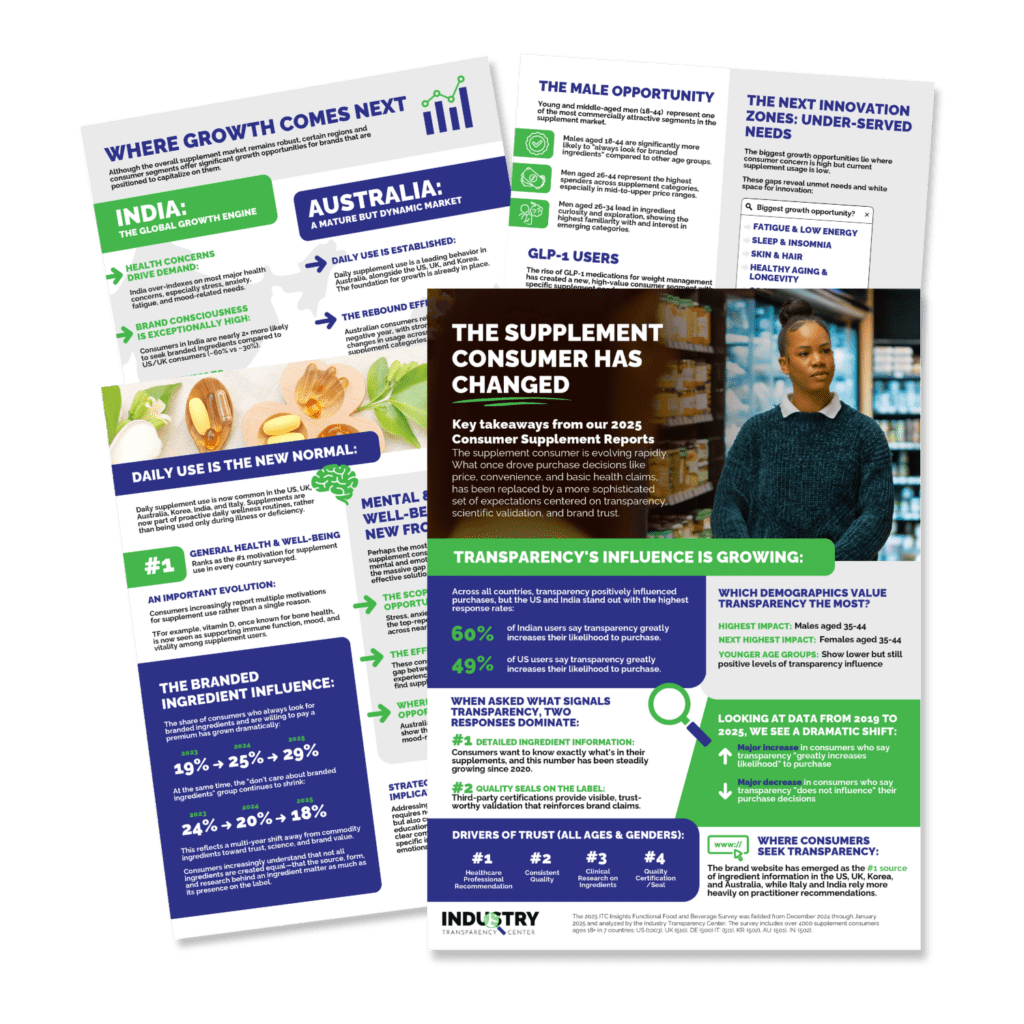
Want to dive deeper into the data?
Download our free Snapshot Report for additional insights and data visualizations, or explore the complete research findings with our 2025 Consumer Reports.