
The Biggest Unserved Opportunities in FF&B
The 5 Biggest Unserved Opportunities in Functional Food & Beverage Right Now
New 2026 consumer data reveals where concern dramatically outpaces FF&B adoption — and where the category has the most room to grow.
Every year, we survey thousands of consumers about what health concerns they’re managing, what functional foods and beverages they’re using to address those concerns, and, most critically, what they would use if the right product existed. The gap between those last two numbers is where the real opportunity lives.
Our 2026 Functional Food and Beverage Survey (n=2,100 US and UK consumers) maps this “whitespace” across 37 health concerns, five age cohorts, and both genders. What it reveals is a category with serious room to grow; not because consumers aren’t interested, but because the FF&B market hasn’t yet delivered convincing solutions across some of their most pressing concerns.
Here are the five biggest.
1. Anxiety, Stress & Mood: The Universal Unmet Need
Let’s start with the number that should stop every functional food and beverage marketer in their tracks.
34.5% of consumers report anxiety or stress as a current health concern. Only 16.8% are using functional food or beverage products to address it, while 24.3% say they would consider doing so. This is a conversion gap of nearly 8%, sitting on top of an education gap of more than 10%.
That’s the single largest opportunity in the entire survey. And it gets bigger when you fold mood in alongside it: 21.7% of consumers report mood as a concern, with only 9.9% consuming FF&B for mood support. The gap between concern and willingness is 7%, showing the widest relative consumption gap of any concern in the top 10.
What makes this opportunity extraordinary isn’t just the size of the numbers, but the breadth. Anxiety and mood whitespace appears across every cohort, every age group, and both genders.
The market has built an enormous supplement category around stress and mood, while the functional food and beverage category largely hasn’t.

2. Fatigue & Mental Energy: Two Concerns, One Unmade Connection
Fatigue is the second most prevalent health concern in the survey at 31.4%. However, the functional food and beverage category has significantly under-served it with only 18.3% of consumers using FF&B for fatigue, while 24.5% say they would. The total opportunity gap is at 13%.
The whitespace is particularly striking for working-age females. Among females 35–44, 43% report fatigue as a concern while only 26% have consumed FF&B for it, and 37% say they would. Among females 55+, the numbers are 39% concern versus 22% consuming. That’s a persistent, broad gap that doesn’t close with age.
Alongside fatigue sits lack of mental energy. This ia a distinct but related concern that 23% of consumers report and only 11.4% are currently addressing with FF&B, despite 18.2% saying they would. The conversion gap here of almost 7% is the third largest in the survey, and it’s female-skewed across all working-age groups.
This matters because consumers frame lack of mental energy differently from physical tiredness. It’s cognitive: the inability to focus, to feel mentally present, to sustain concentration through a demanding day. FF&B brands that speak to both physical energy and cognitive stamina in a single positioning, rather than defaulting to caffeine or generic “energy” claims, are operating in largely unclaimed territory.

3. Sleep: High Concern, Very Low FF&B Presence
21.3% of consumers report insomnia or sleep problems while only 9.6% are consuming functional foods or beverages for sleep support, with 15.4% say they would.
The sleep supplement market is well-established, so why is the sleep FF&B market not when the data suggests consumers would welcome it? The most obvious answer would have been tea; a natural, habitual, pre-sleep ritual with centuries of cultural association around calming and wind-down. But the 2026 data complicates that assumption: tea consumption is declining year over year among functional food and beverage consumers in both the US and UK. If the category’s most intuitive “nighttime elixir” is losing ground, the question isn’t just whether other formats are needed, it’s whether the entire concept of the bedtime functional drink needs a reinvention.
The whitespace is widest and most consistent among older cohorts: females 45–54 show 32% concern versus 10% consuming, and males 55+ show 20% concern versus 7% consuming. Both of those are among the widest single-cohort gaps anywhere in the dataset.
The structural opportunity here is format innovation. Consumers are already accustomed to sleep-supportive ingredients in supplement form. The question is whether the FF&B category can deliver those same ingredients in formats that fit naturally into a pre-sleep routine. And with tea declining, the answer may lie in something that doesn’t exist yet at scale: a functional evening drink that earns its own ritual, rather than borrowing one from a category that’s fading.

4. Joint & Mobility Health: A 55+ Priority With Almost No FF&B Presence
Joint health tells a different story from the first three opportunities. It’s not a universal whitespace but a highly age-concentrated one, where, within that concentration, the gap is enormous.
Among females 55+, 43% report joint or other pain as a concern with only 19% consuming FF&B for it. Among males 55+, the numbers are 35% concern versus 18% consuming. For females 45–54, 30% concern versus 14% consuming.
This is a concern that grows sharply with age, and it’s one where the FF&B category has made almost no meaningful inroads. Joint health in supplement form (glucosamine, collagen, omega-3s, curcumin) is a well-established category. But in functional food and beverage form, it barely exists as a defined proposition.
The education gap is also significant here. The spread between willingness and concern is wide across all 55+ cohorts showing that it isn’t just a product problem, but potentially a communication and category education problem first.

5. Perimenopause & Hormonal Health: The Fastest-Growing Gap in the Dataset
This one is different in nature from the others with a smaller absolute number, but a uniquely underserved market with very few competitors and an urgently growing consumer need.
Among females 45–54, perimenopause/menopause enters the concern profile with significant whitespace: concern is present, awareness is growing, and FF&B solutions are almost nonexistent. The data shows it as one of the largest single-cohort education gaps in the dataset, with the spread between concern and willingness pointing to consumers who haven’t even been told that FF&B could help — not ones who’ve tried and not found it useful.
What makes this opportunity particularly valuable is that females 45–54 are also among the highest grocery spenders in the survey and have established long-term brand loyalty as their primary trust driver. A brand that enters this space credibly, with real ingredient science, clear communication, and a tone that respects her experience will be building a relationship with one of the most valuable consumer segments in the category.

The Bottom Line
Across all five opportunities, a consistent pattern emerges: consumers have the concern and the willingness, but the market hasn’t met them with the right product, messaging, or education.
This isn’t so much of a demand problem as it is an awareness problem. Eighty-three percent of survey respondents reported at least one health concern that prompted FF&B consumption. Eighty-six percent said they would consider functional foods or beverages for at least one health-related reason. The category’s growth ceiling is not defined by consumer interest, but by the industry’s ability to close the gap between awareness and adoption.
The brands that move first into these whitespaces with credible formulations, transparent sourcing, and messaging that connects health concerns to FF&B solutions won’t just capture market share, they’ll define the category for the next decade.
Get the Full 2026 Report — Coming Soon
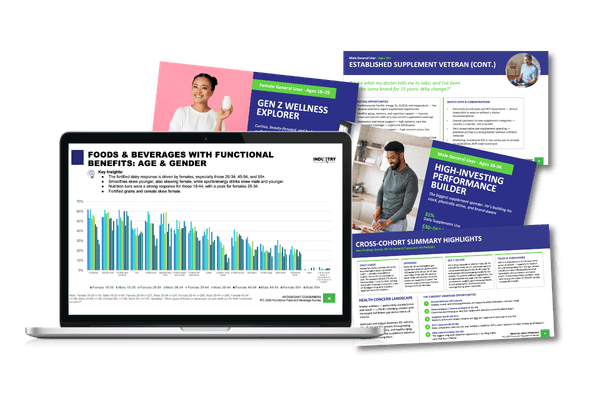
This data is just a preview. The complete 2026 ITC Insights Functional Food and Beverage Report goes deep on all of this and more: full whitespace analysis across 37 health concerns, channel and format data by cohort, ingredient familiarity and perceived effectiveness trends, trust and transparency drivers, branded ingredient purchase intent, and year-over-year comparisons with 2023 and 2025.
Data sourced from the 2026 ITC Insights Functional Food and Beverage Survey, General Consumers (n=2,100 US and UK respondents, fielded May 2026). Whitespace analysis derived from the Health Concern Section of the General Consumers Report.
Filter by Category:

Full 2026 Report Coming Soon
Looking for a specific category, health concern, or demographic?